
blog
The ideal training (also for a horse with a behavioral problem) is when the horse progresses in a straight line upwards. At the bottom of the line we have nothing and at the top of the diagonal line we have the goal we want to reach. The line shows the progress of the horse.

This line shows only progress. The horse, during this training, only progresses. Is this a realistic scenario?
Even if we don’t know how a horse learns we can look at how we learn. Do we know a lesson the first time? Do we need repetition? During learning, do we make mistakes when we do not fully master the subject?
For a horse it isn’t so different from us. They need to regress to learn. I will even tell you that it is necessary to regress to be able to learn something, otherwise they will never learn. As a behaviorist I am always happy to come pass a regression in the work because in this way I have an indication of where the horse is in the training. If he starts to learn and / or if he still needs to learn something. So, don’t be disappointed when your horse does the exercise less and less well. Rather, remember that this is the way they learn and that you are on your way to achieve your goal.
Your curve will look more like this:

blog
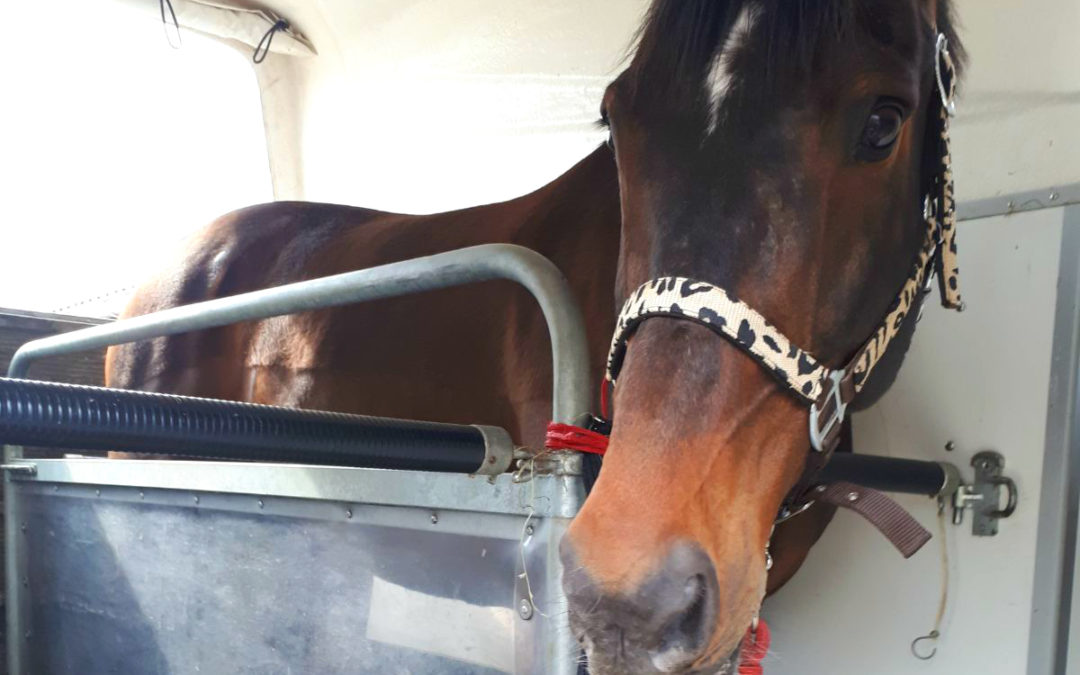
I meet many owners who never take the time to train their horse to walk into a van, trailer, truck or otherwise. Many people think that it is very normal for a horse to enter in a small, often dark, space.
For claustrophobic people, it’s not hard to imagine what a horse feels when he is standing in a van. For others, I think that when you find yourself in a room where the walls are getting closer and closer to you, to finally “crush” you, you can understand the idea. Nobody wants to be in such a situation. Yet, that’s what we ask of the horses.
In addition, horses do not see the environment the same way we do. Their sight, hearing, smell, sensations, etc. are much more developed (or developed in another way). So, what we perceive is nothing compared to them.
Likewise, you all know that a horse is a prey animal. Can he run away in a space like a van when he thinks he is in danger? Is it not against his nature to put him in a van then?
And we can continue this discussion for hours.
They had to adjust, of course, but that doesn’t mean we can ignore their mental, emotional and physical state!
We want them to do so, so the horse has to do it.
However, we also have to teach the horse to let us on his back. To let us lunge him. They must also learn to perform the shoulder in, the half-pass, the piaffe, to jump, etc. So why should we not teach them to get used to walk (and stand) in a van?
As mentioned above, many owners expect their horses to walk directly in a van. And when this is not the case, violence, strength and especially frustration appears.
Why? Because we must also learn to ride a horse, to lunge a horse, how to make a shoulder in, haunches in, a half-pass, to jump, …
Once the method acquired for both, the horse and the owner, there is no problem anymore. The owner knows how to help his horse and the horse knows what he has to do to make his owner happy (or try anyway).
A little more respect is the title of the blog. I mean, from us towards the horses. Despite the fact that they are scared, angry, traumatized, they continue trying for us.
Many horses (of course, they are all different) walk into a van after an hour of training, while they have never seen one before in their whole life. Without using force.
You just have to be patient and listen to what your horse has to say. It’s better to take a little more time to teach him right from the first time than to lose an hour (or more) each time you want to get him into a van.

blog
I was lucky to see magic. Since then, this magnificent moment did not leave my head anymore. So, the only thing I had to do was to share it with you on this blog.
What I saw is the kind of thing we see in movies. It’s beautiful, but is it really what happens in reality?
Of course, when I saw the scene, I was not surprised at all but it touched me deeply.
We, men, have still a lot to learn.
It is often said that we, adults, have to find the purity of a child once more if we want to be or become happy again. Live in the present moment without premeditation thinking. Like horses (or other animals).
I was with a client, we had to catch a horse to get him out of the field. It wasn’t the horse I had to train but we needed his help. Unfortunately, this horse didn’t want to be caught. The owner said that he had this problem often, but I didn’t come for this horse, so we decided to take another one. At the same time, the client’s seven-year-old son says, “She loves me, I can catch her for you.” And he went in the (large) field.
I remember me thinking, “I hope he will succeed otherwise his confidence will be hurt a little” (because he was really sure of himself).
He approaches the horse slowly, this one being a little suspicious but she looks at him with attention and comes closer. The boy catches her gently by the halter and the miracle has happened.
Something, an adult would not be able to do in less than 15 to 30 minutes, or maybe more, in all serenity, the boy did in two seconds.
So, tell me, what do we need to learn from this?

blog
I think that the most difficult thing for an owner, a trainer, a behaviorist, …is to recognize when the horse is in pain. Most of the horses have a high level of tolerance regarding the pain they might have physically.
Or is it a behavior problem? He doesn’t want to listen. He is testing me? Or he still thinks it hurts. A memory of his past that comes up every time you touch him on a particular spot. Or when we put a saddle on him or a bit. A lot of behavior problems are caused by pain somewhere in the body.
Before bringing in someone who can help you with your horse’s behavior, be certain that his behavior is not related to pain that is still present.
How do you recognize the difference between a horse in pain and a memory of pain?
During a training session it is possible to see if the horse still suffers from any pain or if it is just a memory.
If you see that there is an improvement in his behavior during the training you are on the right track.
If, on the contrary, there is no improvement, you can almost be certain that the horse still suffers from something physical (assuming that the trainer is very good at his job).
In addition, if the horse’s behavior deteriorates in the days after the session and you (the owner), have followed exactly the advice of the trainer, or after each session with the behaviorist, he begins to behave as before, he is probably still in pain.
Before coming, the person you asked for help has to warn you when he thinks the behavior of the horse is linked with any kind of pain. Otherwise you will spend a lot of money to someone who is not able to help you because the behavior of the horse is only a consequence of the pain he suffers.
Everything depends on the past of the horse, whether or not he had a wound, a saddle that bothered him, a sharp bit, problems with his teeth, a trauma, etc. You know your horse the best. Trust yourself. Trust your instinct. Trust your horse.
If you have any questions on this subject, do not hesitate to contact me.

blog
Communication. A concept we daily use. As well among people as between a human being and an animal. Despite all the use of our communicative skills, it remains a field in which we keep on experiencing trouble and difficulties. Let us ask ourselves what the reason is for that. What can be done about it and might there be something we can do ourselves.
The reason is quite simple: we, as human beings, are the only species on earth that have the capacity to “think”. This specialty grew into a habit. We all know, that 9 out of 10 times, our mind is winning from our intuition, our true self. But is it not true that intuition is something we all, animals but also human beings, got from nature.
Intuition goes hand in hand with feeling and although we often think that these feelings are in our way, we cannot put them “off” because maybe they want to give us an important message. Nevertheless, we underestimate this force, our true power.
Society want to shape us with its rules, its limitations, its authority … passed on from ancestor to parent to child. We are raised by predetermined plans, goals, wishes, duties.
Our heart reacts like: is this really what we must follow, do we have a choice? The answer is: no, we do not have to follow it and yes, we always have a choice!
Using your mind, thinking things over, is always good unless it dominates our whole culture and gets us far from who we really are. You suffer among it yourself, not being who you truly are deep inside, but it influences also everybody who is in your company.
At the same way, we also have huge communication problems with our horses. And especially those creatures are made to be able and willing, to help us with that. To bring us back to who we really are, our true self. Despite their domestication they have not changed and are still connected, in a special way, with natures wisdom. Horses want to tell you something, teach you something but we seldom listen because we are not expected to do so. Fortunately, they will never stop trying to reach you.
The moment you achieve harmony with any other creature, you yourself are in harmony too. In this moment, you feel powerful and it shows. It is than that the most beautiful images will be created.
It is a way filled with surprises, long drops but also high mountains which you will overcome, together with this amazing creature … or all by yourself.
Communication between a human being and the horse. Find yourself and be your own master, find your horse and become one. Become inseparable and invincible. Become the person you have always wanted to be, your true self, and that’s the greatest gift you can
give to you … and your horse.
